| Organic Seeds | Edible Plants | Organic Pest Controls | Books | Tools, Propagation & Fertilisers | Sprouting & Microgreens | Poultry Supplies | Specials & Gift Ideas |

Top

We will send an email to this address*
when is next available
* we will use this email address only for this notification and then we will delete it.
 Home
Home
Green Harvest Organic Gardening Supplies is permanently closed as of 5pm on 1-11-2023.
We will not be taking orders by this website, in person, by phone or email. Our display garden and retail shop are closed forever.
Read more...
Phone:07 54357000
Phone calls will only be responded to sporadically and only in reference to orders placed prior to 2-11-2023. All the useful growing and organic pest management research and resources are available on this website for a while still.
 AVAILABLE FOR PURCHASE:
buy or get emailed when available
AVAILABLE FOR PURCHASE:
buy or get emailed when availableGINGER GROWING INFORMATION © Frances Michaels
BOTANICAL NAME: Zingiber officinale
COMMON NAMES: keong; khing; gung; halia; jahe; luya; shooga
FAMILY: Zingiberaceae, the ginger family
PLANT DESCRIPTION
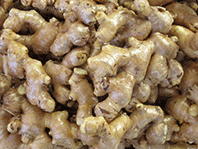
Ginger is a perennial herb native to Asia that grows 1 metre tall with underground rhizomes. The leaves are light green, thin and strap-like. The flowers are green and insignificant. It is native to monsoon forests and requires a well-drained soil, frost-free climate and 1500 mm of rain annually or supplementary irrigation. It thrives best on loamy or alluvial fertile soils and likes the addition of well-rotted manure or compost. It cannot stand waterlogging. Light shade is required, this is provided by pigeon pea in India. In a permaculture system it is a useful understorey plant.
USES
Ginger rhizomes are widely used to flavour cakes, chutneys, curries, candies and beverages. They are sold dry, powdered, preserved in syrup or crystallised. Very young rhizomes, known as stem ginger or green ginger, are peeled and eaten raw in salads, pickled or cooked in syrup. Young, slightly spicy shoots can be used as a vegetable.
PLANTING DETAILS
Allow the ginger to sit in a well ventilated pantry before planting until small 'eyes' (buds) start to develop. The large rhizome can be cut into multiple pieces, each weighing between 50 - 80 g; each piece should have at least 2 'eyes' developing. Allow the cuts to dry out before planting to reduce the possibility of fungus infecting the planting piece. Always avoid planting in cold, wet soils. Plant in spring, when the soil has warmed up, 5-10 cm deep. Ginger is often planted on ridges, usually about 30 cm apart and with 15-23 cm between plants. The crop is planted by setts (small rhizomes) with one or two buds. Approximately 840 -1700 kg of setts are required to plant one hectare. Expected yield would be 10 to 25 t/ha of fresh ginger.
HARVEST
Rhizomes are harvested about 8 months after planting, when the leaves have yellowed or died. It is possible for the home gardener to just dig carefully at the side of a clump and remove rhizomes as needed rather than harvesting the whole clump.
Not to NORFOLK ISLAND, NT, SA, TAS or WA
SORRY but due to quarantine restrictions between Australian States no plants at all can be ordered by residents of Norfolk Island, Tasmania and Western Australia. These restrictions are very important as they prevent the spread of plant pests and diseases. No potatoes, garlic, shallots, strawberries or tubestock can be sent to South Australia. No tubestock can be sent to Northern Territory.
Home
Green Harvest Organic Gardening Supplies is permanently closed as of 5pm on 1-11-2023.
We will not be taking orders by this website, in person, by phone or email. Our display garden and retail shop are closed forever.
Read more...
Phone:07 54357000
Phone calls will only be responded to sporadically and only in reference to orders placed prior to 2-11-2023. All the useful growing and organic pest management research and resources are available on this website for a while still.
DISCLAIMER:
No liability will be accepted by Green Harvest, its owners or employees as to the accuracy of any information. No responsibility will be taken for damage to property or persons due to information given about a product or technique. No responsibility will be taken for the loss of a crop or income due to information given about a product or technique.
 Shopping here is private and secure.
Copyright © 2001 - 2024 Green Harvest Organic Gardening Supplies
No part of this website may be reproduced without permission of the owner
SORRY but due to quarantine restrictions between Australian States no plants at all can be ordered by residents of Norfolk Island, Tasmania and Western Australia. These restrictions are very important as they prevent the spread of plant pests and diseases. No potatoes, garlic, shallots, strawberries or tubestock can be sent to South Australia. No tubestock can be sent to Northern Territory.
Home
Green Harvest Organic Gardening Supplies is permanently closed as of 5pm on 1-11-2023.
We will not be taking orders by this website, in person, by phone or email. Our display garden and retail shop are closed forever.
Read more...
Phone:07 54357000
Phone calls will only be responded to sporadically and only in reference to orders placed prior to 2-11-2023. All the useful growing and organic pest management research and resources are available on this website for a while still.
No liability will be accepted by Green Harvest, its owners or employees as to the accuracy of any information. No responsibility will be taken for damage to property or persons due to information given about a product or technique. No responsibility will be taken for the loss of a crop or income due to information given about a product or technique.
Shopping here is private and secure.
Copyright © 2001 - 2024 Green Harvest Organic Gardening Supplies
No part of this website may be reproduced without permission of the owner